
Writing · Analysis · Commentary
A New Iron Curtain
Digital Power and the Future of Civil Liberty
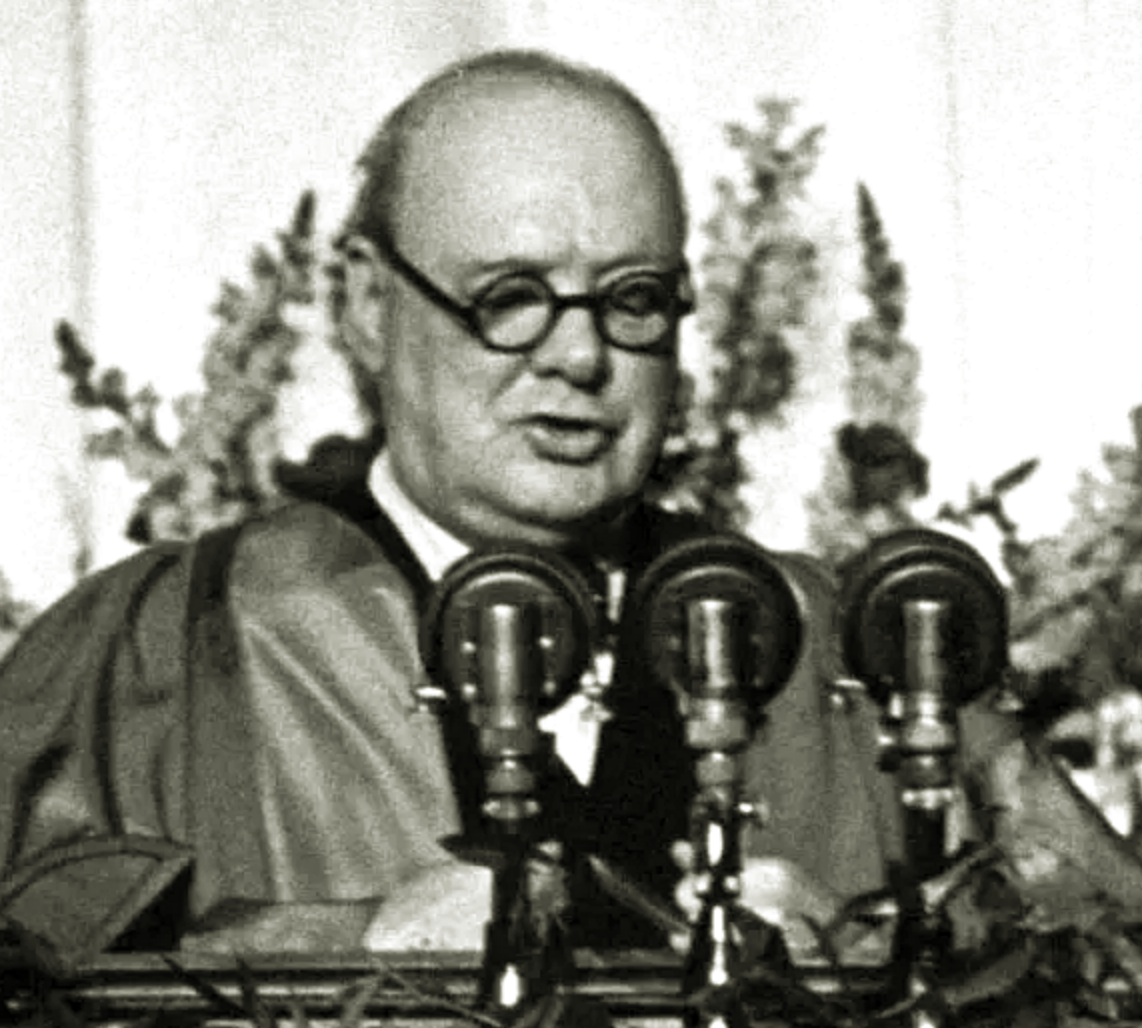
On March 5, 1946 in Fulton, Missouri, Winston Churchill delivered a speech that would frame the Cold War. An “Iron Curtain,” he warned, had descended across Europe.
The phrase captured more than a geopolitical divide. It marked a difference in governing principle.
The ruin of the Second World War had forced a question that would shape the next era of history: what kind of political order would emerge from the wreckage — and whether it would be free.
Would governments exist to secure liberty, or would liberty exist only by the permission of power?
Across Europe, two competing answers began to take form.
On one side stood regimes that treated speech as a danger to be managed, opposition as a threat to be neutralized, and political life as something to be supervised.
On the other stood constitutional systems built on a contrary claim: that liberty precedes power, and that authority is legitimate only within limits.
Churchill underscored a structural truth that modern democracies risk forgetting: political liberty rests upon civil liberty.
Elections without protected speech become ritual. Likewise, parliamentary forms without genuine representation become mere performance.
Civil liberty is not incidental; it is foundational.
The Iron Curtain of the twentieth century was visible in barbed wire and guard towers. It announced itself in border fortifications and secret police archives.
A digital curtain, if it descends, would be less visible and therefore more difficult to confront — subtle in form, yet restrictive in effect.
It would not require tanks or decrees. Its power would reside in opacity — shaping the conditions of speech and association in ways that obscure the very fact of constraint.
It would take shape through regulatory frameworks, liability structures, compliance mandates, algorithmic filtering, and expansive monitoring capacities — embedded within systems that preserve democratic form while concentrating discretion in administrative institutions and narrowing democratic accountability.
That difference in method does not eliminate the need for vigilance. It merely changes where vigilance must be applied.
The essential question is not whether societies regulate speech. Every society does. The question is where the burden of justification lies.
In a free order, power must explain itself before intruding into private life. In a managed order, the citizen must explain himself before being left alone.
That reversal — subtle at first — is where the architecture of liberty begins to shift.
Civil Liberty Before Political Power
Churchill’s warning carried force because it rested on a clear understanding of liberty — an understanding that contemporary institutions increasingly conflate.
The distinction between civil liberty and political liberty is not theoretical. It determines whether elections function as genuine expressions of self-government or merely as mechanisms of managed consent.
Political liberty structures participation in governance — elections, representation, legislative debate, and the lawful contest for authority.
Civil liberty protects the conditions that make such participation meaningful: conscience, association, expression, due process, and freedom from arbitrary state intrusion.
A system that calls itself democratic must ground its legitimacy in the protection of the people’s rights.
It is not enough to speak of liberty while simultaneously expanding the authority of administrative bodies that operate beyond meaningful public accountability and define the limits of their own power.
A democratic government must preserve liberty not merely through its procedures, but through restraint. The first duty of a free government is to limit itself.
Democracy is not satisfied by elections alone. The people must retain rights that exist prior to and independent of the state.
Nations can continue to hold elections long after the conditions that give those elections meaning have eroded.
Participation in governance must reflect genuine self-government, not symbolic inclusion. Authority in such a system flows upward from citizens toward accountability, not downward as an instrument of domination.
When government claims the power to define and enforce the boundaries of speech and association, it risks diminishing agency and inverting the very order from which its legitimacy arises.
A system may retain political procedures while eroding its legitimacy by constricting civil protections. Elections may be held. Parliaments may convene. Opposition parties may exist in name, but when the space for dissent, expression, and organization narrows, political choice narrows with it.
This contrast became a defining feature of the emerging Cold War.
In the Soviet sphere, electoral mechanisms operated within a single-party system where speech, association, and political organization were subject to ideological supervision.
Elections occurred, but dissent was suppressed and political power remained firmly concentrated within the ruling party.
In the Western sphere, legitimacy rested on the principle that civil liberty precedes and constrains the power of the state.
Without that condition, political liberty becomes ritual rather than substance, and elections risk becoming ceremonies that confirm power rather than instruments that limit it.
Privacy and Power in the Digital Age
If civil liberty is the precondition of a genuine self-governing system, then privacy is the precondition of civil liberty.
When speech and association take place under the expectation of scrutiny, expression narrows and relationships grow guarded. Conscience begins to anticipate reaction rather than pursue truth.
A people may still speak — but gradually they begin to think within limits shaped by the knowledge that they are being watched.
Twentieth-century totalitarian systems understood this intuitively.
Their methods were overt: informants, secret-police archives, and visible punishment. Modern systems need not replicate the form to reproduce the comparable effect.
Digital life introduces a profound asymmetry.
The same infrastructure that makes communication effortless also makes monitoring, indexing, and enforcement frictionless.
Where the Soviet state required manpower, modern administrative systems require pipelines.
A serious account of liberty in the digital age must therefore treat privacy not as a consumer preference, but as an essential element of political architecture.
Privacy prevents civil liberty from becoming conditional — speech and association existing only by permission, within boundaries defined by acceptable risk.
In prior eras, the protection of civil liberty depended upon physical limits: walls of the home, sealed correspondence, localized authority, and the friction of distance. In a digitized society those natural limits disappear.
Communication is instantaneous, storage is permanent, and monitoring is inexpensive.
If liberty is to remain more than aspirational, limits must now exist not only in law but in the architecture of digital systems themselves.
As surveillance capabilities expand, so too have efforts to preserve confidential communication.
At the center of those efforts stands cryptography.
Often dismissed as a technical specialty, its true significance is political. It is a structural limit on coercive power.
Strong encryption embodies a simple proposition: some domains of human communication cannot be rendered transparent to intrusive authority without breaking the system itself.
For that reason encryption sits in natural tension with regimes that treat information visibility as a normal condition of governance.
The familiar objection is deceptively simple: If you are not doing anything illegal, what do you have to hide?
But the question reverses the burden of a free society. It replaces the presumption of innocence with an expectation of perpetual legibility.
The supposed opposition between liberty and security appears repeatedly in moments of institutional expansion. Yet liberty and security are not adversaries. They must coexist in proper balance.
The more meaningful question is whether the threat invoked is ever defined clearly enough — and proportionate enough — to justify the powers claimed in its name.
Even where safety is sincerely pursued, a free people must ask whether it can be secured without eroding the structural safeguards on which liberty depends.
In the digital sphere those safeguards are technical as well as legal.
Regulatory approaches increasingly reshape the architecture of communication itself — mandating risk-mitigation systems, expanding metadata retention, imposing liability pressures, and requiring platforms to police user behavior pre-emptively.
Capabilities embedded in infrastructure rarely remain narrow. History shows this repeatedly.
Assurances of restraint from present authorities are transient. What will endure are the systems being constructed—systems that future actors will inherit, whether or not restraint remains a consideration.
Digital governance also alters the logic of surveillance.
Historically, surveillance required justification because it was expensive and selective. A state needed a reason to watch a person.
When communication is continuously captured, stored, and indexed, the sequence reverses. Information is collected first…justification follows thereafter. Surveillance shifts from targeted observation to broad accumulation. Once the record exists, the rationale for examining it can always be supplied after the fact.
A system does not need to declare censorship in order to produce it. It only needs to make certain speech costly, risky, slow, or reputationally dangerous — especially when enforcement is opaque and appeals are remote.
Governance by Risk Architecture
European regulatory developments illustrate the emerging pattern — not because they replicate Soviet systems, but because they risk normalizing the infrastructure of information control within political orders that still claim democratic legitimacy.
The concern is incremental inversion: the gradual redefinition of private communication as preemptively monitorable and institutional access as preemptively justified.
The UK Online Safety Act provides a clear example.
Official descriptions emphasize duties, systems, and processes designed to reduce illegal content risks.
Yet where such duties intersect with encrypted or private communication, the practical question should be: how does one mitigate risk without inspecting content?
The tension is not theoretical. It intersects with the broader British surveillance environment, including the Investigatory Powers Act and high-profile disputes involving encryption providers and government access demands.
These are not secret-police archives. They’re modern administrative systems embedded within platforms and overarching compliance regimes.
Their effect is rarely dramatic repression. It is gradual reorientation toward another end entirely.
Communication once assumed private becomes conditionally visible. Association once informal becomes reviewable.
Liberty ceases to function as the default condition of civic life. It becomes contingent.
It should be said and repeated regularly that: in a free system the people are not assets of the state.
Governments do not create the people; the people create governments.
Legitimate authority derives only from visible consent, exercised by citizens drawn from among the governed.
Power claimed in the name of protection cannot invert that relationship without weakening the legitimacy from which it derives.
On the European Union side, the EU Digital Services Act introduces governance through obligations, audits, and systemic risk frameworks — vocabulary through which speech conditions increasingly become administratively managed.
When states embed permanent risk-management frameworks into digital systems, governance changes in structure as well as scope.
The West long claimed that human flourishing requires both privacy and the free flow of information.
When governing institutions invert that ordering — treating supervision as foundational and liberty as conditional — they gradually weaken the moral authority of their own systems.
Officials frequently insist encryption is not being abolished, only subject to “proportionate mitigation.” Yet proportionate to what threat, measured by what evidence, and bounded by what safeguards?
Where inspection becomes embedded in infrastructure, private space ceases to be presumptive. It becomes conditional.
A New Curtain
This returns us to Churchill’s central insight. The Iron Curtain was never merely a line on a map.
It reflected a deeper difference in political anthropology — how regimes understood the citizen and the source of legitimacy.
Ideas shape institutions.
Institutions shape daily life.
Power may appear through visible coercion, or through less visible administrative and technical systems that structure ordinary existence.
In either form the underlying question remains the same: who governs whom, and on what moral basis?
Does political order begin from the premise that the citizen is a moral agent whose rights precede the state?
Or does it treat the citizen as a subject whose liberty exists within boundaries defined by institutional discretion?
That distinction determines whether civil liberty restrains power — or power conditions liberty.
A digital curtain does not require barbed wire or guard towers. It can emerge through liability regimes, accreditation systems, algorithmic filtering, and institutional standards — justified as safety measures and enforced through compliance.
Where the twentieth century relied on visible coercion, the twenty-first risks reliance on managed systems that make dissent costly, privacy uncertain, and free association contestable.
The warning, then, is not that Europe or Britain has become the Soviet bloc. The warning is more subtle and uncomfortable: the West risks importing the same governing premise — speech as a managed hazard — while preserving the outward rituals of democratic life.
When civil liberty becomes conditional, political liberty follows.
The Iron Curtain once divided territory.
A new curtain, if it forms, will divide premises.
It will not announce itself with barricades.
It will settle into systems.
And the decisive question will not be what those systems claim to protect — but what liberties gradually vanish within them.