
Writing · Analysis · Commentary
Deterrence at the Threshold
Iran’s nuclear trajectory and the limits of non-proliferation
Serious strategic problems rarely appear as sudden crises. More often they arise through the quiet accumulation of capability.
The most consequential changes in power develop incrementally—technical at first, but gradually acquiring unmistakable strategic significance.
Nuclear proliferation follows this pattern with particular clarity.
In matters of strategy, isolated events matter less than the direction of capabilities. The accumulation of power over time is what brings states to decisive thresholds.
What begins as research programs, infrastructure, and technical progress can, over time, place a state in an entirely different category of power. Such transformations rarely occur in a single dramatic moment. They emerge gradually, as accumulating capabilities begin to carry strategic consequences.
For decades, Iran has invested in nuclear enrichment capabilities and ballistic missile forces capable of reaching much of the Middle East. These capabilities have little to do with civilian energy needs but carry obvious implications for regional security calculations.
Viewed individually, each development can be debated. Taken together, they point in a single direction—and it is the task of nonproliferation policy to confront such trajectories before they mature into capability.
The Breakout Problem
At the center of the issue lies the problem of breakout—the shrinking interval between existing capability and the production of a weapon. The question is not simply what exists today, but how rapidly circumstances could change if Iran chose to move from capability to construction.
As centrifuge performance improves and enriched stockpiles expand, the timeline to weapons-grade material contracts. A program long described as civilian begins to assume the characteristics of a weapons capability.
Some enrichment levels have already reached roughly 60 percent purity—far beyond what civilian power generation requires and only a short technical distance from weapons-grade material.
At that point the matter ceases to be theoretical. Compressed timelines alter the strategic environment and place greater weight on the indicators surrounding the program.
Infrastructure and Intent
In matters of proliferation, infrastructure often reveals more than official declarations. Civilian energy programs tend to be visible and integrated into national power systems. Programs designed to preserve strategic capability look very different.
Facilities buried deep within mountains and hardened against air attack are difficult to reconcile with routine civilian power generation. They are far easier to understand as protection for sensitive military capabilities.
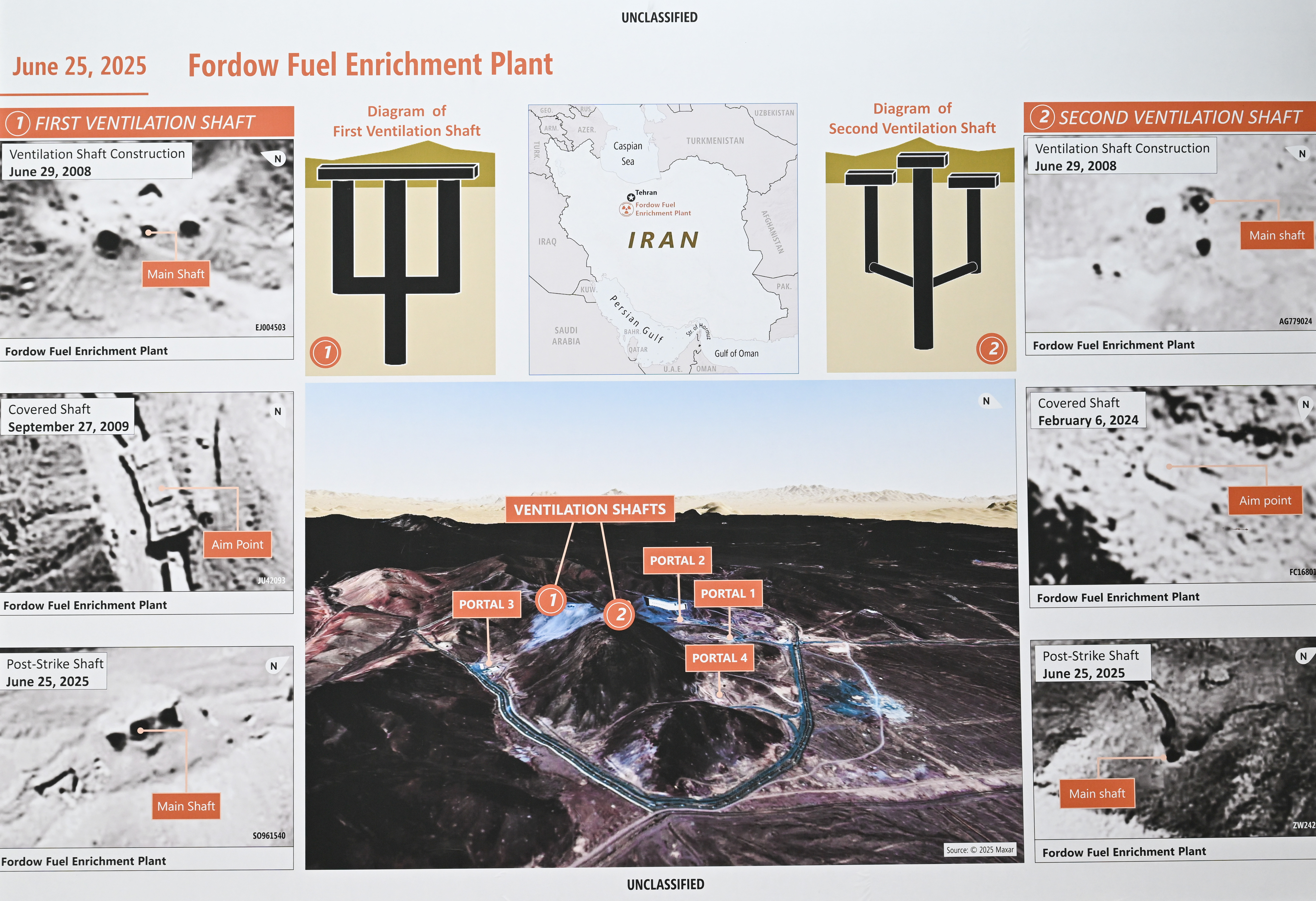
The Fordow enrichment facility, built deep within a mountain and designed to withstand the heaviest air strikes, illustrates the difference between an ordinary energy program and one built with strategic survivability in mind.
A serious assessment draws conclusions not from public declarations but from the clearer evidence of program architecture.
Delivery Systems
No nuclear capability exists without delivery systems, and Iran has spent decades developing them.
Iran’s ballistic missile forces can now reach targets across much of the Middle East and beyond.
Such forces make sense not as components of legitimate civilian technological development, but as instruments of coercion and regional power projection.
Iran now fields ballistic missiles with ranges exceeding 1,000 miles (roughly 1,500–2,000 kilometers), placing much of the Middle East within reach. Systems such as the Shahab-3, Emad, Ghadr, and Sejjil exemplify that capability.
When enrichment capability, hardened infrastructure, and long-range delivery systems advance in parallel, they should not be viewed as unrelated developments. Together they point toward a deliberate strategic objective.
The Logic of Non-Proliferation
American defense doctrine—and much of the international community—has long treated nuclear capability differently from ordinary industrial or conventional weapons development.
States that demonstrate transparency and restraint are given latitude. But states that accumulate strategic capability while rejecting oversight and threatening their neighbors are treated with increasing suspicion.
This distinction is not ideological. It is prudential.
Responsibility and Order
Across the Middle East, countries including Israel, Saudi Arabia, and the Gulf states such as the United Arab Emirates and Qatar view the prospect of an Iranian nuclear breakout as a direct threat to regional stability.
Their concern is not theoretical. A nuclear-armed Iran would alter the region’s strategic balance and could trigger further proliferation.
When dynamics of this kind converge, the issue expands beyond technical compliance to questions of responsibility.
Since the middle of the twentieth century, the United States and its partners have often acted—however imperfectly—as a stabilizing force within the international system. That role carries obligations, particularly when the spread of nuclear weapons threatens cascading instability.
The moral reasoning behind such responsibilities is not new. From Aristotle onward, political thinkers have argued that war is justified only insofar as it preserves a just and durable peace. The just war tradition later articulated by Thomas Aquinas—and reflected in the political philosophy of Islamic thinkers such as Al-Farabi and Al-Mawardi—recognizes that preserving order may sometimes require difficult choices when other measures fail.
The Strategic Principle
History repeatedly shows that the most dangerous moments in international conflict occur not when a weapon first appears, but when a volatile actor approaches the threshold at which it could suddenly transform the balance of power.
Technical arguments alone will not settle the proliferation debate. Most have already been made, alongside decades of diplomatic concessions.
The remaining question is whether the international community is prepared to recognize where this trajectory leads—and to act before the threshold is crossed.
Strategists learn early that waiting for absolute certainty often means waiting until it is too late.