Writing · Analysis · Commentary
Memorandum or Misunderstanding
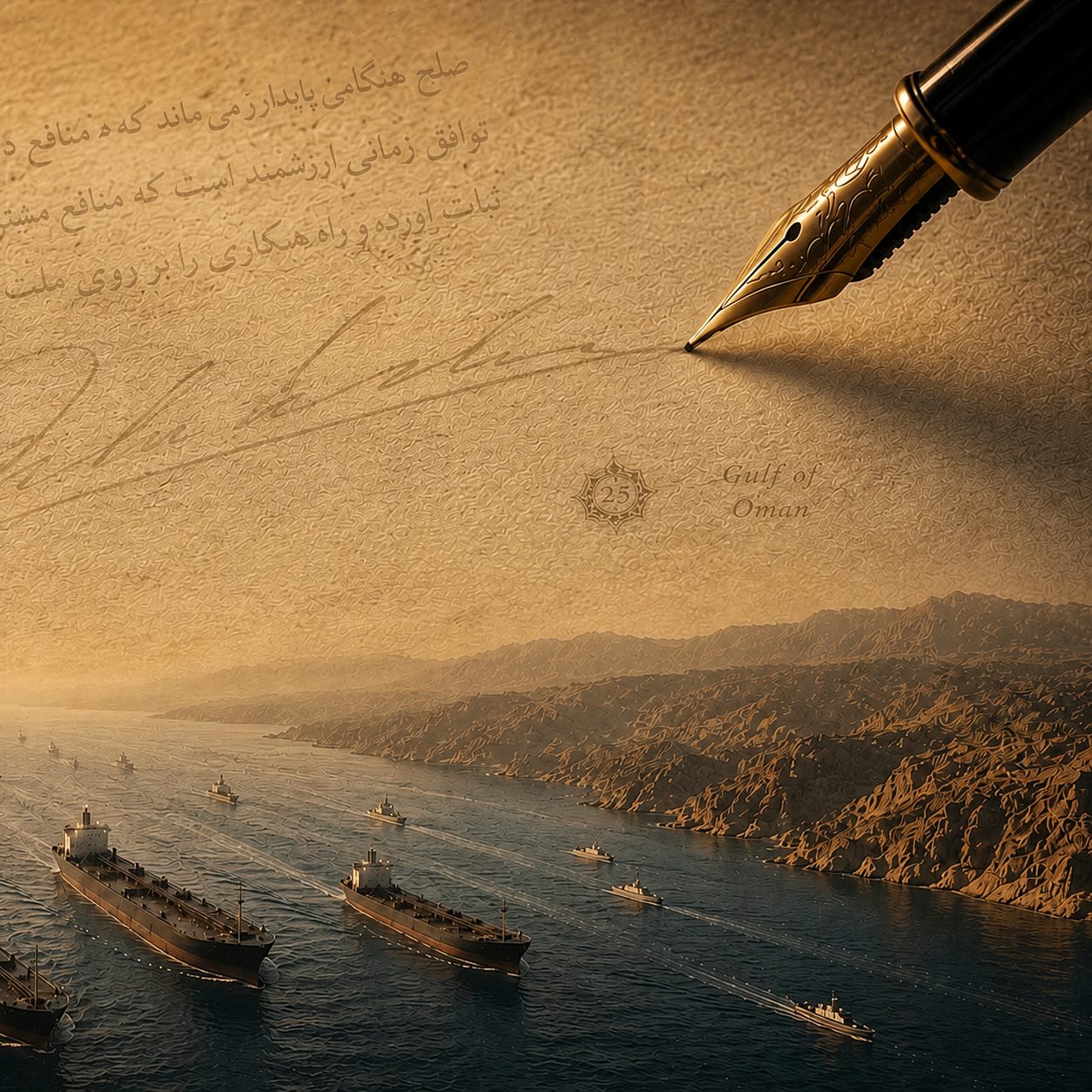
The Difference Between Signing and Sustaining an Agreement.
“Treaties are observed as long as they are in harmony with the interests of those who have the power to break them.”
>
— Napoleon Bonaparte
Peace Is a Continuing Calculation
Peace exists when the principal actors in a dispute conclude that the costs of conflict exceed its benefits. As we are quickly finding out, agreements are often the result of that conclusion, not the cause of it.
Agreements that endure require multiparty consent, contemplate and exercise good faith, and ultimately, interests, incentives, and conditions that brought them into being must also continue to exist.
When those conditions disappear, the agreement frequently disappears with them.
The foundations of peace might rest on deterrence, prosperity, exhaustion, fear, shared interests, political necessity, or some combination of them all.
But whatever their source, they are seldom permanent. Peace is not a permanent destination, it’s a continuing calculation.
History is filled with agreements that appeared durable when they were signed, only to prove fragile later. Looking back, their failure never stemmed only from the language on the page. The problem was usually found in the political, strategic, and institutional conditions that failed to sustain it.
The negotiations between the United States and Iran are no exception.
The significance of any future agreement will not be determined by what it promises. It will be determined by whether it changes the calculations of the parties expected to honor it.
At its core, the dispute between Washington and Tehran is more than a disagreement about nuclear enrichment, centrifuges, missiles, or inspections—beneath the surface, it’s a disagreement about intention, and intentions are notoriously difficult to measure.
Capabilities can be counted, but intentions must be inferred. Technical capabilities lend themselves to observation—strategic ambition does not.
Inspectors can visit facilities. Intelligence agencies can monitor activity. Centrifuges can be counted. Stockpiles can be estimated, but ideological objectives can’t simply be audited in the same way as equipment can be monitored.
Future decisions cannot be inspected before they are made.
That reality explains why no memorandum, treaty, or agreement can erase nearly half a century of mistrust overnight.
No document can instantly reconcile competing interests.
No signature can guarantee future conduct. At best, an agreement can alter incentives.
A well-constructed arrangement can accomplish some things. It can increase the costs of confrontation.
It can increase the benefits of cooperation.
It can make compliance more attractive than conflict.
If that is its purpose, it stands a good chance of offering some measure of shared understanding.
Yet agreements are often judged by the optimism surrounding their signing rather than their ability to survive the pressures that follow.
The value of an agreement isn’t revealed when everything is working smoothly, it’s revealed when circumstances change.
The celebration comes first—the test comes later, and the real test begins when compliance becomes costly.
That lesson is particularly relevant when evaluating any future arrangement between the United States and Iran.
The central question is not whether an agreement can be negotiated. The central question is whether it can endure.
The Problem of Political Durability
Any agreement between Iran and the United States will only survive if and when the principal actors conclude that preserving it serves their interests more than abandoning it.
The weakness of the Obama-era nuclear agreement was endemic to the process and not simply a byproduct of the limitations of its technical provisions. Its greater vulnerability was always political.
Large portions of the American political system never accepted ownership of the agreement. Many opposed it from the beginning, while some reluctantly supported it only conditionally.
As a result, the arrangement remained exposed to electoral change and shifting political winds.
Eventually, those winds changed.
The lesson is straightforward. Agreements resting on narrow political foundations are inherently fragile.
Durability requires legitimacy broad enough to survive elections, changes in leadership, fluctuations in public opinion, and disagreements among political factions.
Agreements intended to endure must command support beyond the officials who negotiate them.
Since issue reaches beyond institutional process or constitutional procedure, the commitments by Secretary of State Rubio, Vice President Vance, and President Trump to involve congress may prove just as important as the details of the agreement itself.
This strategy domestically is about broadening support, gaining necessary buy-in, and creating broadly shared collective political ownership.
Verification Is Not Trust
Every agreement is, in some sense, an attempt to manage uncertainty.
Not to eliminate it entirely—but to manage it.
Among the most insightful analysis we hear an important refrain, namely that verification mechanisms should never be mistaken for expressions of trust. They exist precisely because trust is insufficient.
Inspections, monitoring systems, reporting requirements, enforcement provisions, and compliance mechanisms are not evidence that uncertainty has disappeared—they are evidence that uncertainty remains.
There is a certain irony in this. The more extensive the inspections, the more elaborate the verification regime, and the more detailed the enforcement provisions, the less confidence the parties generally possess in one another’s future conduct.
Trust reduces the need for safeguards. Distrust multiplies them.
But trust is not necessary if verification and consistent performance are measurable. for that reason, any repatriation of funds, unfreezing of assets, sanctions relief, or compensation should remain tied only to directly to measurable, verifiable changes in conduct.
Concessions granted in expectation will only invite uncertainty; whereas concessions earned through demonstrated compliance will reinforce accountability.
Unconditional Freedom of Navigation
The same principle applies to freedom of navigation. There can be no “toll for passage,” nor any assertion of coercive control over international waterways. No matter what racketeering scheme may be cooked up to turn the Strait of Hormuz into a toll station, such an arrangement would be and should be totally rejected as unacceptable.
The free flow of commerce through the world's maritime chokepoints is not just about economic interest, it’s a longstanding indispensable principle of international order.
The United States confronted this challenge more than two centuries ago. Between 1801 and 1805, it fought the First Barbary War to end piracy, tribute demands, and interference with commercial shipping in the Mediterranean.
When asked why the United States should pay tribute, President Thomas Jefferson identified the fundamental problem: “The style of the demand admitted but one answer.” His point was that tribute was not a negotiable point but an invitation to future ruinous demands.
The outrageous conduct against merchant vessels galvanized the public calling for military action. The principle was later captured in one of the most enduring phrases of the early republic: “Millions for defense, but not one cent for tribute.”
A decade later, after having already made an agreement, during the Second Barbary War, American forces were compelled to return to reinforce the lesson that piracy, extortion, the seizure of vessels, and coercive interference with lawful commerce would not be tolerated.
More than two centuries later, the underlying logic remains unchanged.
Commercial access, freedom of navigation, and the lawful use of international waterways cannot be conditioned upon coercion, intimidation, tribute, or demands for payment.
The architecture of any agreement must safeguard these long-established principles of conduct and international order.
It must reflect not only what the parties have accepted in word, but what they are prepared to uphold in deed. As agreements are not ultimately judged by the language they contain, but by the conduct they produce.
Agreements Require Enforcement
Thomas Hobbes captured the problem centuries ago when he observed: “Covenants, without the sword, are but words.”
The durability of agreements depends on the willingness and ability of the parties to honor and enforce them when circumstances change and compliance becomes inconvenient.
History offers many examples.
During the Cold War, the United States and the Soviet Union negotiated arms-control agreements despite profound ideological hostility and deep strategic mistrust.
Those agreements did not emerge because trust suddenly appeared.
They emerged because both sides concluded that unmanaged competition carried greater risks than managed competition.
Verification became a substitute for trust.
Monitoring became a substitute for confidence.
Reciprocal obligations became a substitute for certainty.
The agreements endured where incentives remained aligned. They weakened where they did not.
The same question confronts policymakers today. Not whether trust suddenly exists between Washington and Tehran. It does not.
The question is whether an arrangement can be constructed that remains politically sustainable, strategically advantageous, and institutionally durable when future leaders, future crises, and future pressures inevitably test it.
Questions That Matter
For most citizens, the practical question is much simpler:
Will it work?
The honest answer is that nobody knows.
Agreements concern the future, and the future remains uncertain.
The more useful questions are these:
- What are the realistic alternatives to an agreement?
- Would perpetual sanctions, military strikes, economic isolation, or maritime interdiction prove sustainable over the long term, and would they achieve the desired outcome?
- Does the agreement create incentives for compliance?
- Does it impose meaningful costs for violation?
- Does it enjoy sufficient political support to survive future elections and future administrations?
- Does it address the underlying sources of conflict, or merely postpone them?
- Does an agreement create conditions under which peace becomes more advantageous than confrontation?
Most important of all:
Has Iran reached a point at which prosperity, stability, and integration into the international system are viewed as more valuable than continued confrontation?
If the answer is yes, the foundations for a durable agreement may exist.
If the answer is no, no amount of technical detail will compensate for its absence.
“You can't go back and change the beginning, but you can start where you are and change the ending.”
>
— C.S. Lewis
The Real Test
In the weeks ahead, debate will focus on details—enrichment levels, inspection authorities, sanctions relief, verification mechanisms, and implementation timelines.
Those questions are important and they deserve serious consideration. But none fully answers the question that matters most.
There should be no misunderstanding about the question that matters most.
The ultimate test of any arrangement with Iran is whether the political, strategic, and institutional conditions necessary to sustain it will continue to exist after the negotiations have ended.
Agreements are not truly tested when they are signed. They are tested when circumstances change, pressures mount, and tensions rise.
Nearly half a century of hostility suggests caution. We may hope for a permanent end to conflict, but history provides little basis for assuming that it will.
The durability of any agreement will depend not upon the ceremony of its signing, nor upon the declarations of success that accompany it, but upon the incentives, consequences, and political resolve that remain after the signatures have dried.
We must enter and exit any negotiation with the understanding that agreements are not sustained by optimism. They are sustained by interests, accountability, and the willingness to act when those agreements are tested.