
Writing · Analysis · Commentary
Pax Deorum — The Peace of the Gods
Crisis, Conscience, and Political Coercion
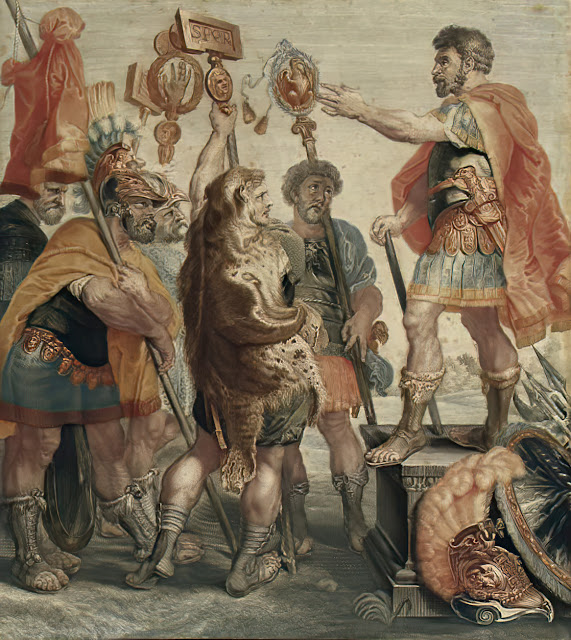
Every civilization constructs its own pax deorum—its own explanation for why order exists and why misfortune must be appeased. Once such explanations become embedded in the institutions that govern public life, belief hardens into orthodoxy and dissent is labeled as subversion.
In periods of stability societies tolerate a remarkable degree of intellectual diversity. During crisis that tolerance begins to contract. The Roman Empire provides a revealing example.
The polytheistic religion of Rome was not originally structured around exclusivity. The imperial system was, in fact, unusually accommodating. Conquered peoples were generally permitted to maintain their own religious practices, and the Roman pantheon expanded readily as new territories were incorporated.
What mattered was not uniform belief but participation in the civic rites believed to maintain the pax deorum—the peace between the human community and the divine order.
The underlying heuristic was straightforward. Rome prospered because the correct relationships between heaven and earth were preserved. If adversity entered the system—failed harvests, military defeat, economic instability—the most plausible explanation was that those relationships had been disturbed.
Within such a framework Christianity presented a structural problem for Rome.
Christians did not merely introduce another deity into the Roman religious environment. They rejected the environment itself.
Refusal to sacrifice to the emperor or the traditional gods was not interpreted as a private conviction, but as a withdrawal from the civic responsibilities believed to sustain the political order itself.
Early Roman administrators often treated Christianity as a marginal sect within Judaism. But as the empire entered the prolonged instability of the third century, the interpretive framework of the pax deorum acquired renewed political urgency.
The reign of the emperor Decius illustrates the turning point.
By the middle of the third century the empire was experiencing simultaneous crises: external invasion, internal rebellion, economic dislocation, and environmental stress affecting agricultural production. In such conditions uncertainty becomes intolerable. Societies begin searching not merely for explanations but for explanations capable of restoring a sense of control.
In response to crisis, Rome invoked emergency authority, issuing decrees and compulsory public obligations in the name of necessity. Decius’ response was not arbitrary persecution but systemic coercion intended to compel universal participation and bind the population to the act itself.
The emperor ordered all inhabitants of the empire to offer sacrifice to the Roman gods and obtain certificates confirming their compliance. Some of these certificates of sacrifice (libelli) still survive. The policy was issued with the declared aim of restoring the divine favor believed to sustain the stability of the empire.
Because the Christian faith placed conscience under the authority of God alone, Christians could not comply without abandoning the principles that defined their belief. For Roman authorities this position appeared dangerously subversive.
The conflict therefore revealed something deeper than religious intolerance. It exposed a fundamental tension between allegiance to transcendent moral authority and obedience to the demands of the state.
What Christians understood as fidelity was interpreted as civic defiance.
The resulting persecution reveals something deeper still: how societies under pressure convert explanatory frameworks into instruments of policy—and, in excess, into publicly justified acts of irrationality.
The sequence is historically familiar.
First comes crisis. Events no longer conform to expectations, and the public experiences a growing sense of disorder.
Second comes interpretation. Leaders and institutions advance narratives capable of explaining the disruption and identifying its causes.
Third comes consolidation. The explanation becomes socially embedded. Repetition, authority, and institutional endorsement transform interpretation into consensus.
Finally comes enforcement. If the explanation is correct, those who resist it appear to threaten the collective good. Policy shifts from persuasion to coercion.
The Roman attempt to restore the pax deorum fits this pattern with remarkable clarity. The empire was not merely punishing Christians for theological deviance. It was attempting to restore systemic equilibrium according to the prevailing assumptions of the age.
From the Roman perspective, refusal to sacrifice was not principled dissent but civic endangerment.
What makes this episode historically valuable is that it reveals the psychological mechanisms operating beneath political decision-making. Human communities struggle to distinguish between explanation and certainty. Faced with instability, they gravitate toward interpretive systems that transform uncertainty into moral clarity.
The intellectual structure supporting the Roman system rested upon circular reasoning reinforced by social authority.
Two intersecting logical fallacies were operating simultaneously.
First, petitio principii—begging the question—appeared in historical form:
Rome prospers because the gods are pleased →
If Rome suffers, the gods must be displeased →
If the gods are displeased, someone must have violated the rites →
Therefore enforcing the rites will restore prosperity.
The premise assumes its own conclusion.
Second, the system functioned as an unfalsifiable belief structure. No possible evidence could disprove it.
If crops failed, the gods were angry.
If crops succeeded, the sacrifices worked.
Every outcome confirmed the theory.
Social psychologists sometimes describe such systems as self-sealing belief structures, in which contradictory evidence is reinterpreted as confirmation. Once this occurs dissent is no longer treated as disagreement. It becomes a threat to prevailing power.
Systems of belief of this kind are not confined to antiquity. Whenever societies confront instability, they construct explanations meant to restore coherence to events that otherwise appear chaotic. Once such explanations become institutionalized, questioning them is no longer treated as inquiry but as subversion.
The consequences are predictable. Intellectual inquiry narrows. Social pressure increases. Institutions align themselves with the prevailing narrative because institutional legitimacy becomes tied to its preservation. Over time alternative explanations cease to be debated and begin to be suppressed.
Every age develops its own vocabulary through which disorder is interpreted and responsibility assigned. The language changes—divine displeasure, historical inevitability, scientific consensus, ideological necessity—but the political dynamic often remains recognizable.
A society convinced it has already discovered the unquestionable cause of its difficulties becomes increasingly impatient with necessary skepticism.
At that point, explanation ceases to function as inquiry and begins functioning as coercive dogma. Ideological conformity that unbalances reason and power, creating doctrines that demand unquestioned obedience—even unto death.
We harm ourselves if we adopt maximalist thinking around the exceptional achievement of modern society. We are not immune to the same false assertions and wrong-headed conclusions that affected the ancients. A society convinced it has already discovered the unquestionable cause of its difficulties soon loses patience with skepticism.
The lesson is not that past societies were foolish while modern ones are enlightened. The lesson is that the human desire for certainty under strain can transform interpretation into compulsion with surprising speed.
Today we risk far more, because the stakes have risen.
Enforced consensus regimes that play on a heightened emotional state possess extraordinary political power because they simplify complexity. They transform ambiguous problems into moral imperatives.
They also convert policy debates into tests of loyalty. In doing so they offer psychological comfort to populations struggling with uncertainty. Yet they carry a danger: the suppression of dissent prevents societies from correcting their own errors.
The Roman world eventually learned this lesson through a long and costly process. Attempts to enforce religious uniformity did not restore the stability Decius hoped to achieve. Instead they exposed the limits of coercion as a tool for resolving intellectual and spiritual conflict.
History rarely repeats itself in identical form, but the pattern is sufficiently consistent to justify attention.
Periods of crisis continue to generate explanatory frameworks capable of mobilizing institutions and shaping public policy. Whether those frameworks remain open to examination or harden into dogma often determines whether a society preserves intellectual freedom.
Civilizations are tested not only by the crises they face, but by the explanations they choose to trust.
Those explanations must remain subject to reason, evidence, and moral restraint. Otherwise the pursuit of order can become the justification for its destruction.
The Romans believed they were defending the survival of their civilization.
That belief may have been sincere—and, as in our own time, sincerely wrong. Its coercive enforcement came at a high cost.