
Writing · Analysis · Commentary
The Ballot and the Republic
How universal vote-by-mail alters the relationship between the citizen, the ballot, and the republic.
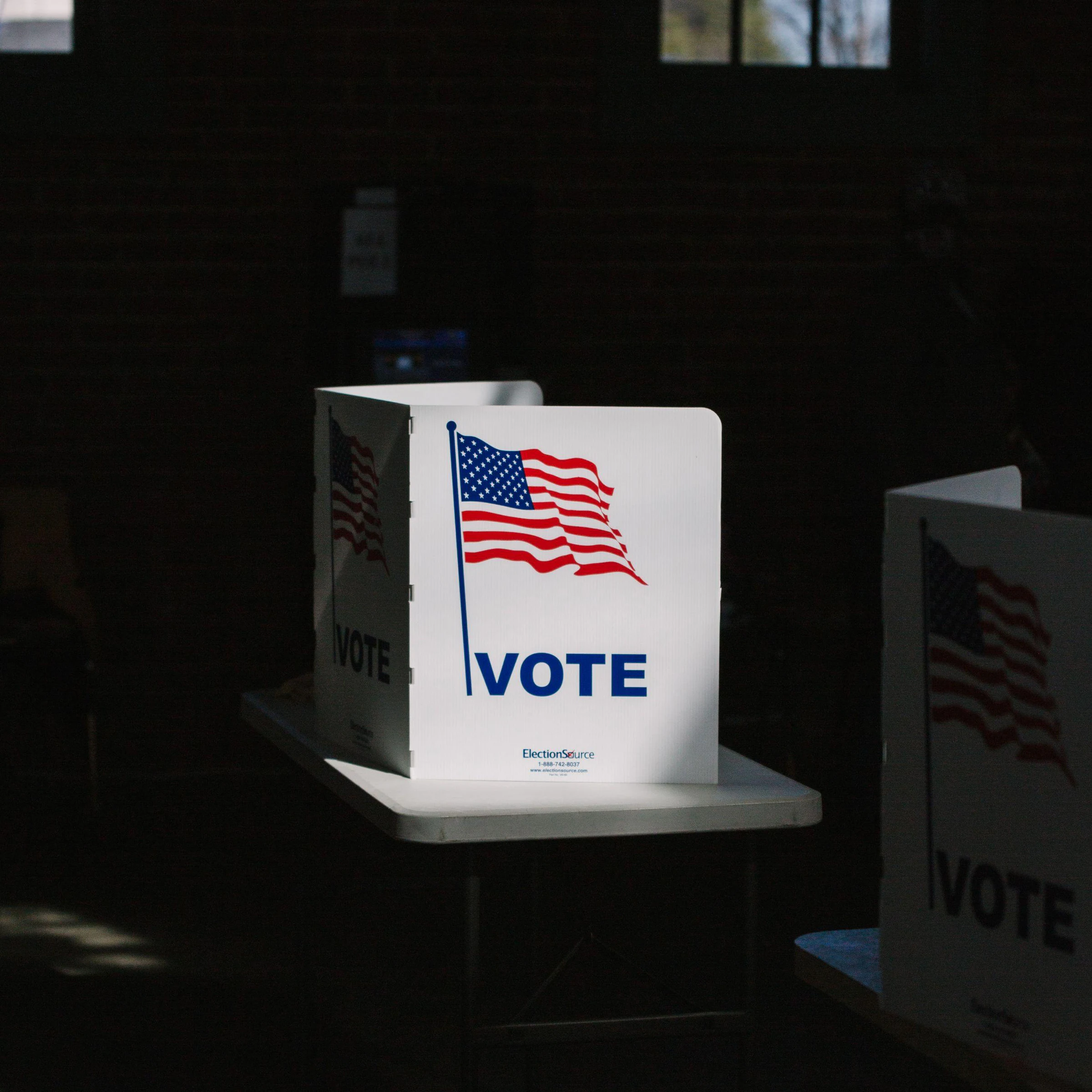
Universal vote-by-mail is often presented as a simple modernization of election administration. In reality, it represents a substantial alteration in the relationship between the citizen and the act of voting itself.
The central issue is not whether every mailed ballot is fraudulent. It is whether a constitutional republic can indefinitely preserve public confidence while progressively replacing direct civic verification with distributed administrative assumption.
The modern movement toward universal vote-by-mail represents a substantial departure from the inherited civic structure central to the nation’s foundational values.
For generations, that arrangement was not considered incidental, but indispensable. Election processes emerged through generations of political experience, including historical periods marked by coercion, patronage, ballot manipulation, machine politics, and contested legitimacy.
Many of the election practices Americans have come to regard as ordinary—secret ballots, precinct voting, voter registration, standardized procedures, and in-person verification—were reforms born from difficult post-Civil War lessons concerning the fragility of self-government and the ease with which political systems can become detached from public confidence.
The rules governing the system themselves have increasingly become objects of permanent political struggle because altering the mechanics of participation may, under certain conditions, prove more decisive than winning the public debate on the merits.
The question gradually shifts from “Which side better persuaded the public?” to “Which side more effectively managed the machinery of participation itself?”
Under such conditions, the language of “democracy” increasingly risks becoming procedural rather than substantive. Public discourse continues to celebrate participation in the abstract while political energy becomes concentrated upon administrative systems, turnout engineering, data management, ballot logistics, legal maneuvering, and institutional process control. The mechanics surrounding the vote gradually become more politically consequential than the civic argument preceding it.
In such an environment, the incentive to persuade the public on the merits may diminish relative to the incentive to shape, expand, manage, or strategically exploit the procedural architecture through which participation occurs.
Elections become less centered on ideas, character, statesmanship, persuasion, and public deliberation and increasingly dependent upon organizational infrastructure, administrative sophistication, and operational asymmetry.
Political talent correspondingly shifts away from civic leadership and toward managerial expertise. The central actors become less the public persuader or constitutional statesman and more the data strategist, institutional operator, procedural litigator, and bureaucratic systems manager.
No republic should become indifferent to that transformation. Self-government ultimately depends upon legitimacy of process, integrity of administration, and proximity between the citizen and the civic act itself.
Confidence in direct and accountable systems creates trust, generating the social capital necessary for cohesion, compromise, and ultimately stable constitutional government.
Such is the hallmark of a sustainable republic: one in which the public believes political authority is earned principally through persuasion of the citizenry within a fair and accountable process, rather than through superior mastery of increasingly administrative systems of participation.
Yet advocates of universal vote-by-mail speak principally in the language of political science theory, emphasizing convenience, accessibility, participation, and administrative modernization.
Critics, however, increasingly argue that something more fundamental is at stake: namely, whether the republic is gradually substituting direct civic verification with distributed administrative assumption.
At the same time, criticism of universal vote-by-mail is frequently caricatured as consisting solely of simplistic allegations of “mass election fraud,” allowing opponents to narrow the debate into a question of statistical criminality alone. Academic studies and institutional analyses are then often cited to argue that widespread fraud has not been demonstrated at levels sufficient to alter election outcomes.
Yet that framing misses the deeper concern entirely.
The central objection is not merely whether large-scale fraud can be conclusively proven after the fact. The more meaningful concern is structural: whether election systems increasingly dependent upon administrative diffusion, indirect verification, extended chains of custody, procedural opacity, and institutional assumption gradually weaken public confidence, civic visibility, and the direct relationship between the citizen and the act of voting itself.
A republic does not rest solely upon an impossible standard of complete absence of fraud. It rests upon public confidence in legitimacy, visible procedural integrity, and a broadly shared belief that the citizen himself—not an abstraction, not an algorithm, not a chain of intermediaries—stands directly behind the ballot cast in his name.
Universal vote-by-mail changes the character of elections because it disperses what was once a singular civic act across a sprawling administrative network composed of databases, mail systems, residential assumptions, signature reviews, drop boxes, curing procedures, third-party collection systems, and backend verification protocols largely invisible to the public itself.
“If democracy dies in darkness,” then public confidence in voting may erode through a different but related danger: the gradual expansion of administrative systems so diffuse, opaque, and procedurally disconnected from direct civic participation that the mechanisms once responsible for building public trust no longer remain visible to the citizen himself.
The Problem of the Outbound Ballot
Universal vote-by-mail depends upon a foundational assumption: that voter registration databases accurately correspond to living, eligible, current occupants at valid addresses. Yet no large database remains perpetually current, particularly within a nation as large, mobile, and administratively fragmented as the United States.
People move, die, relocate temporarily, maintain multiple residences, or simply fail to update registrations as quickly as bureaucratic systems require. Records persist beyond their practical validity while citizens relocate and reorder their lives faster than administrative systems can continuously maintain with precision. These are not extraordinary breakdowns, but ordinary realities within a vast and mobile republic.
In the weeks preceding an election, state and regional election authorities distribute ballots en masse according to the names and addresses contained within centralized voter-registration databases. The act of distribution itself is largely administrative.
Whether the intended voter still resides at the address, personally receives the ballot, or remains lawfully qualified to participate is not fully resolved at the moment the ballot enters circulation. Those questions are deferred downstream into broader systems of assumptions, verification procedures, signature reviews, and post-distribution safeguards intended to validate legitimacy after the fact rather than directly at the point of issuance.
Under traditional precinct-based voting, many such imperfections were naturally contained because the citizen himself had to appear physically before election officials. Presence functioned as a final validating mechanism. The act of appearing resolved uncertainty in a way no database fully can.
Critics argue that this distinction is fundamental. Under precinct-based systems, eligibility and participation were more directly joined together in a singular civic act characterized by physical presence, localized verification, and immediate accountability.
Under universal vote-by-mail, however, the system operates initially upon administrative confidence in the underlying data and only subsequently attempts to confirm legitimacy through indirect verification mechanisms occurring after distribution has already taken place.
Critics increasingly argue that this transforms voting from a person-centered civic act into a location-centered administrative exercise. The distinction is subtle, but profound.
The Problem of the Inbound Ballot
If the outbound question is “Who actually received the ballot?”, the inbound question is in many respects even more difficult: Who completed it?
Once ballots leave supervised civic environments, the state loses much of its ability to guarantee secrecy, independence, freedom from coercion, and uninterrupted chain of custody.
In-person voting isolates the voter from many outside pressures. Remote voting, by contrast, re-embeds the act of voting within social and relational environments consisting of families, employers, activist organizations, institutional networks, and third-party collection systems.
This concern is not merely theoretical. The secret ballot itself emerged during the nineteenth century precisely because earlier voting systems proved vulnerable to intimidation, patronage, landlord pressure, organized machine politics, and outright vote-buying.
Prior generations learned through experience that the more intermediaries placed between the citizen and the ballot box, the greater the opportunity for influence, manipulation, pressure, and uncertainty.
Universal vote-by-mail inevitably expands the number of intermediaries involved in the process.
Supporters of mail voting frequently point to signature verification as a sufficient safeguard. Yet signatures are not remotely equivalent to direct physical verification. They vary with age, injury, stress, health, habit, and time. Signatures change, as do the technologies employed to assess them, including optical character recognition systems and increasingly automated forms of review. Yet according to what standard, and established by whom?
Likewise, when a ballot is challenged and requires human consideration, signatures are evaluated inconsistently across jurisdictions and often under substantial administrative pressure. One county may reject ballots another county would accept. One reviewer may see authenticity where another sees discrepancy.
The issue is not merely whether fraud occurs. The issue is whether the public can meaningfully observe and trust the process by which legitimacy in government itself is determined.
A republic cannot indefinitely sustain public confidence through procedural assurances alone, particularly when many of the safeguards invoked exist largely beyond public visibility and often depend upon diffuse administrative enforcement mechanisms that ordinary citizens neither directly observe nor fully understand.
Statutes, regulations, verification protocols, and backend procedural controls may all exist de jure on paper, yet public confidence ultimately depends upon whether those safeguards remain visible, comprehensible, enforceable, and de facto connected to direct civic accountability in practice.
In an age increasingly characterized by selective enforcement, perceived double standards of justice, declining institutional trust, and intense partisan politicization across major public institutions, confidence is sustained less through abstract procedural assurances than through processes the citizen can directly observe, understand, and regard as fundamentally fair.
Trust in a republic is not secured merely by the existence of guarantees, but by the visible credibility of the systems through which those guarantees are supposedly maintained.
Ballot Harvesting and the Return of Intermediary Politics
The expansion of third-party ballot collection may represent one of the most significant structural changes in modern election administration. Once organized actors are permitted to collect, transport, cure, and manage ballots, political competition increasingly shifts away from persuasion and toward logistical management.
Campaigns develop sophisticated ballot-harvesting operations while activist organizations, institutional networks, unions, and political advocacy groups build elaborate turnout and ballot-retrieval systems designed not merely to persuade voters, but to manage the mechanics of participation itself. Elections increasingly become contests not simply of ideas, but of organizational infrastructure and administrative reach.
Critics argue that this resembles, in technologically modern form, the intermediary political systems earlier election reforms sought to dismantle.
The old urban political machines of the nineteenth and early twentieth centuries depended heavily upon neighborhood operatives, assisted voting structures, patronage networks, transportation systems, and managed turnout operations. Many Progressive Era reforms were explicitly designed to reduce intermediary control and restore greater directness between citizen and ballot.
Universal vote-by-mail partially reverses that trajectory.
Motor Voter and the Rise of Administrative Assumption
These concerns intensify further when universal vote-by-mail is combined with automatic registration systems, Motor Voter frameworks, same-day registration, limited citizenship verification standards, and increasingly diffuse administrative databases.
The National Voter Registration Act of 1993 was intended to expand participation by integrating voter registration into ordinary administrative interactions such as DMV visits. Yet critics argue that the broader effect was philosophical as much as procedural. The system gradually shifted from deliberate civic enrollment toward passive administrative inclusion, with eligibility increasingly presumed unless disproven.
This matters because the United States does not maintain a universal citizenship registry, a national voter identification system, or a fully integrated interstate verification framework.
Instead, election administration depends upon overlapping layers of state databases, DMV records, self-attestation systems, county maintenance procedures, partial federal matching programs, and uneven local standards that vary significantly from jurisdiction to jurisdiction.
At precisely the moment ballots are increasingly distributed automatically and remotely, verification itself has become more diffuse, fragmented, and difficult for ordinary citizens to observe directly.
Even where actual improper voting remains statistically limited, confidence may nonetheless decline because the public no longer clearly understands where direct verification truly occurs.
And public confidence matters far more than claims of participation rates.
A constitutional republic depends not merely upon technical integrity, but visible legitimacy.
Electoral Systems and Partisan Consolidation
The political trajectory of many universal vote-by-mail states is difficult to ignore, even if the precise relationship between election structure and partisan outcomes remains debated.
Nearly every state that ultimately adopted universal vote-by-mail has, over time, moved toward increasingly durable democrat partisan dominance at the statewide level, particularly in presidential elections, Senate races, and institutional control of state government.
Oregon, which became the first universal vote-by-mail state following Ballot Measure 60 in 1998, had once been politically competitive and for much of its earlier history leaned moderately Republican in national elections. Since implementing all-mail elections, however, Oregon has voted Democratic in every presidential election while Democratic control of statewide offices and legislative institutions steadily consolidated over time.
Washington followed a similar trajectory. Counties gradually transitioned toward vote-by-mail beginning in the mid-2000s before statewide implementation was completed in 2011. Over roughly the same period, Washington evolved from a historically competitive state with substantial split-ticket voting into one of the more reliably Democratic states in the country at both the presidential and statewide levels.
Colorado presents another notable example. Prior to adopting universal vote-by-mail in 2013, the state was widely regarded as one of the nation’s quintessential swing states. A state carried by Republicans as recently as 2004 was strategically selected by the Democratic Party as the site of its 2008 convention and the presidential nomination of Barack Obama. In the years following implementation, Democrats increasingly consolidated statewide electoral advantages while Republican statewide victories became markedly less frequent.
Nevada, more recently added to the list of universal vote-by-mail states, remains politically competitive at the presidential level but has nonetheless experienced increasingly intense partisan conflict surrounding election administration, ballot collection practices, procedural legitimacy, and public trust.
Utah remains the principal outlier. It is the only consistently Republican state to maintain universal vote-by-mail over an extended period, though even there Republican lawmakers recently moved to scale portions of the system back while adding stronger identification and verification requirements tied to state-issued credentials.
That development itself is revealing, because it demonstrates growing concern—even among many Republicans who previously accepted mail-based systems—that public confidence increasingly depends upon stronger visible verification standards and narrower chains of custody.
The Fading Luster of the Golden State
California provides perhaps the clearest modern example of how the transition away from traditional precinct-based elections occurs incrementally rather than all at once.
The process did not begin with a sudden statewide declaration of universal vote-by-mail. It emerged gradually through a series of administrative and legislative changes that collectively altered the structure of voting itself.
While California had already been trending according to a partisan divide prior to its full embrace of universal vote-by-mail, the state’s transition through expanded mail-ballot systems, vote centers, and extensive drop-box infrastructure coincided with the near-total collapse of Republican competitiveness in statewide officeholding.
A major turning point came with the enactment of the California Voter’s Choice Act in 2016 through Senate Bill 450. Rather than immediately eliminating neighborhood polling places statewide, the law initially established a pilot framework allowing participating counties to transition toward a new election model centered around mailed ballots, regional vote centers, extended voting periods, and expanded ballot drop-box infrastructure.
Under the prior precinct-based system, voters generally appeared within defined local polling locations tied directly to neighborhood voter rolls and geographically fixed communities. The Voter’s Choice Act substantially altered that arrangement. Ballots were mailed broadly to registered voters, traditional polling locations were reduced or consolidated, and voters could cast ballots by mail, at drop boxes, or at centralized vote centers located throughout an entire county rather than solely within their immediate precincts.
The significance of this transition extended beyond convenience alone. The structure of the election itself increasingly shifted away from a single-day civic event rooted in neighborhood participation and toward a distributed administrative process operating across multiple weeks, locations, and collection methods.
As ballot drop boxes proliferated and vote-center voting expanded, election administration became increasingly detached from geographically localized civic participation.
Importantly, the transition was introduced incrementally through pilot counties before broader statewide normalization occurred. What began as an optional modernization framework eventually became the operational foundation for California’s broader movement toward universal vote-by-mail elections, the most complete model of an election process operating according to many of the concerns raised herein.
In this respect, California illustrates how large structural changes in election administration often emerge gradually through layered procedural reforms that, over time, fundamentally alter the relationship between the voter, the ballot, and the election system itself.
None of this, by itself, conclusively proves that universal vote-by-mail creates only partisan outcomes. Many of these states were already undergoing demographic, cultural, urban, educational, and economic transformations independent of election procedure alone. Serious analysis requires acknowledging those realities plainly. Correlation is not causation, and any intellectually serious argument must resist simplistic or conspiratorial explanations.
Yet the broader pattern remains politically and structurally significant enough that it cannot simply be dismissed as irrelevant. Critics argue that universal vote-by-mail systems may tend to advantage political coalitions possessing stronger institutional, bureaucratic, nonprofit, union, academic, activist, and turnout-management infrastructures capable of maximizing distributed ballot participation over extended voting periods.
The Loss of the Common Civic Moment
There is another loss less frequently discussed, though perhaps no less important.
Traditional Election Day compressed democratic participation into a common national moment. Citizens voted together. The act carried symbolic weight precisely because it occurred simultaneously across the republic, binding participation to a shared civic occasion recognizable to the nation as a whole.
Universal vote-by-mail transforms elections into extended intake periods spread across weeks.
Ballots arrive at different times. Voting occurs under shifting information environments. Campaigns adapt dynamically to emerging turnout data while political operations refine targeting efforts in real time. The election becomes less a singular act of civic judgment and more a rolling administrative process.
Something civic is diminished in that transition.
The republic may become procedurally efficient while simultaneously becoming spiritually thinner.
Individual Citizenship and Collective Power
In its broadest form, the polarity within the modern political system increasingly falls along a fundamental philosophical divide.
On one side are political theories, institutional arrangements, and governing models rooted primarily in collectivist assumptions—systems that tend to view political participation principally through the lens of aggregate social power, administrative coordination, and collective outcomes.
On the other are traditions more heavily grounded in ordered liberty, established constitutional norms, intermediary institutions, and the primacy of the individual person, the family, and the local community as the foundational units of civic society.
That distinction increasingly shapes the debate surrounding elections themselves.
One political instinct tends to view voting primarily as a mechanism for maximizing collective participation and administratively expanding democratic throughput. The other tends to regard voting first as an individual civic duty requiring direct accountability, visible legitimacy, and personal responsibility exercised within carefully maintained constitutional structures.
Under the former conception, emphasis naturally gravitates toward procedural scalability, administrative accessibility, and the broad expansion of participation mechanisms. Under the latter, greater weight is placed upon verification, chain of custody, institutional restraint, transparency, and preserving the direct relationship between the individual citizen and the act of voting itself.
These competing assumptions do not merely produce policy disagreements. They reflect fundamentally different understandings of citizenship, sovereignty, civic trust, and the proper relationship between the individual and the state within a constitutional republic.
At the same time, it is important to distinguish universal vote-by-mail from the much broader category of absentee voting generally.
Twenty-eight states currently allow what is known as “no-excuse absentee voting,” meaning any voter may request a mailed ballot without providing a reason, while other states maintain permanent absentee lists allowing voters to opt permanently into mailed voting.
These systems differ substantially from universal vote-by-mail because the ballot is still affirmatively requested by the voter rather than automatically distributed by default to every registered name and address contained within statewide databases.
That distinction is not merely technical. Critics argue it preserves an important element of intentional civic action. The citizen must still initiate participation directly rather than simply becoming the passive recipient of a ballot generated through administrative assumption.
Historical Warnings
The United States has confronted election integrity problems before. During the Civil War, absentee voting emerged on a large scale because Union soldiers were deployed far from home.
Even then, controversies surrounding fraud, custody, legality, and constitutional authority arose immediately. Importantly, those systems were understood as exceptional wartime accommodations tied to identifiable military populations—not universal civilian distribution.
The Reconstruction era and subsequent decades witnessed extensive problems involving ballot stuffing, patronage systems, coercion, machine politics, and manipulated turnout operations.
New York’s infamous Tammany Hall political machine and similar corrupted political organizations mastered the art of intermediary control. Elections in many jurisdictions became exercises not merely in persuasion, but in organized management of access, turnout, and dependency.
The reforms that followed were not arbitrary innovations. Secret ballots, standardized ballots, precinct voting, registration systems, and in-person verification procedures emerged as institutional responses to accumulated abuses.
Their purpose was to reduce uncertainty by reconnecting the individual citizen directly to the act of voting itself.
A Republic Requires More Than Convenience
The strongest defense of stricter election procedures is not hostility toward participation. It is recognition that self-government depends upon public trust in the integrity and visibility of the process itself.
Convenience is not the highest political good.
Confidence matters. Legitimacy matters. Custody matters. Transparency matters. Direct civic accountability matters.
A free people must be able not only to vote, but to believe the system visibly preserves the equality and authenticity of each citizen’s participation.
That does not require abolishing absentee voting by mail altogether. Legitimate accommodations will always remain necessary for military personnel, the disabled, the ill, travelers, and citizens facing exceptional circumstances. But accommodations should remain accommodations, not the universal default structure of the republic itself.
A Possible Path Forward
A restoration-oriented reform agenda would likely begin with several principles. Election Day would once again become the primary mechanism of voting, accompanied perhaps by limited early voting windows but anchored fundamentally in precinct-based participation and direct civic presence.
Absentee voting could remain available while returning to a request-based structure tied to individualized verification rather than automatic mass distribution.
Stronger identity verification standards—including government-issued photo identification, citizenship confirmation procedures, residency verification, and improved interstate coordination—could strengthen public confidence regardless of the prevalence of actual fraud.
Third-party ballot harvesting could be narrowly limited in order to reduce intermediary political influence and strengthen chain-of-custody integrity, while election procedures themselves could be standardized and made more transparent across jurisdictions so citizens more readily understand how elections are being safeguarded.
These reforms should primarily occur through state legislatures, which retain broad constitutional authority over election administration under Article I, Section 4 of the Constitution.
In some states, reforms could also emerge through ballot initiatives or referenda. Courts, meanwhile, continue to play an important role in balancing access, equality, procedural integrity, and constitutional protections, while a definitive constitutional case could potentially move election administration further toward equal protection and accountability standards.
The Supreme Court itself has repeatedly recognized that states possess legitimate interests not only in preventing fraud, but in preserving public confidence in elections.
That distinction is crucial.
For a republic ultimately survives not because elections are merely declared lawful, but because the people broadly believe them to be legitimate, intelligible, and worthy of trust.
The ballot is not simply an administrative instrument. It is the visible expression of popular sovereignty and the direct extension of personal accountability as a free citizen.
A sovereign people should therefore remain cautious before allowing any alteration, expansion, or restructuring of so essential a civic process to become too distant from the direct act from which democratic legitimacy itself is originally derived.